|
To advance the practice, and engage people in the opportunity, of turning atmospheric carbon into soil organic matter (oxidize less, photosynthesize more).
Submitted by Peter Donovan on Tue, 02/02/2010 - 8:41pm
Filmmaker John Liu has documented the World Bank's $500 million loess plateau watershed rehabilitation project since it began in 1995. He has made at least two compelling films about the project, including a 22-minute version was shown at the recent Copenhagen climate conference, and a more detailed 52-minute version.

Watch the films here: http://eemp.squarespace.com/film-channel/
Or watch the Lessons film on Youtube.
Thanks to Tony for the tip.
Submitted by Peter Donovan on Fri, 01/08/2010 - 4:34pm
We are embarking on a mapping project for measured changes in soil carbon content over time. The purpose is not to aggregate "offsets" or to make broad predictions, but to show what's possible as verified by actual measurements.
There are many stories that are told about soil carbon, and what its possibilities are. The bulk of research on this topic has substituted assumptions for observations. Repeated measurements at the same location appear to be rare.
There are only a few data points so far and we hope to collect, review, and add data as we can. If you have data you would like to include, or can suggest good data, please contact us at info at soilcarboncoalition dot org, or you may start with a data form attached below.
Carbon gains and losses are expressed in metric tons of carbon (not carbon dioxide) per hectare per year.
The map
You may use the Google Earth version if you have Google Earth installed.
Otherwise use the Google Maps version.
Conversions
To convert carbon to CO2, multiply by 3.67. For CO2 to C, multiply by .273. (The molecular weight of CO2 is 16 for each oxygen atom, and 12 for the carbon atom, so the ratio of CO2 to C is 44:12.)
To convert hectares to acres, multiply by 2.47.
To convert acres to hectares, multiply by .404.
To convert metric tons to short tons, multiply by 1.1.
To convert metric tons C per hectare to short tons CO2 per acre, multiply by 1.63.
Submitted by Peter Donovan on Thu, 01/07/2010 - 10:57am
Submitted by Peter Donovan on Tue, 12/08/2009 - 11:20am
It is often said that you can't unscramble an egg. An egg has a wholeness or integrity, a poised arrangement of membranes and layers. You cannot reverse the breaking, mixing, and cooking, even with the most advanced technology and equipment.
But a hen can. Feed her a scrambled egg or two, and she can lay a new, whole egg. It may not be instant, but expensive technology is not required. If the egg is fertile, it can become a new hen, who can unscramble more eggs, and so on.
It's important to remember the relationship here, and who has the power. The hen wants to eat it, and produce a new egg, for reasons that are hers, not ours. Like all the biosphere's organisms, she is self-motivated. Trying to force her may cause problems for both her and us. If we want the egg unscrambled, we invite her.
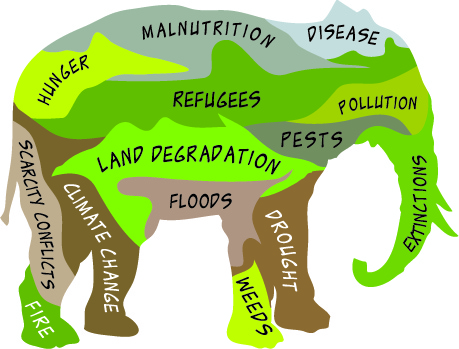
We've got a scrambled egg situation on a global scale: biodiversity loss, extensive land degradation, water shortages, acidifying oceans, and too much heat-trapping carbon in the atmosphere. But we've framed it in such a way that the hen isn't even in the picture.
Of all these large problems, it was perhaps inevitable that carbon in the atmosphere took center stage in the 1970s and after. The data about rising carbon dioxide in the atmosphere were clear. Physical sciences were dominant in climate questions, and the scope and variability of the biological carbon cycle were only beginning to emerge.
That transparent carbon dioxide gas absorbed and emitted long-wave radiation, thus trapping heat, had been discovered in the 1800s. By the 1960s it was clear that atmospheric carbon dioxide was increasing steadily. But it took another generation, as well as a massive and varied accumulation of evidence, before most scientists and the public began to accept the possibility that climate could change as a result of human activities, and that fossil fuel burning was the main driver.
Submitted by Peter Donovan on Wed, 11/18/2009 - 9:24am
Skeptics of anthropogenic global warming often attribute the power to change climate to solar output (astrophysics).
Most climate activists place the power for change with fossil fuel emissions (technology). But more are now recognizing that changing technology, such as emissions reductions, lacks near-term leverage on the whole system and on atmospheric carbon. Being proactive won't help much, because the system is too narrowly defined.
Reflecting more solar energy into space, or air capture of carbon using technology, is attractive to some because it corresponds to a widespread technical orientation, as well as frustration or impatience with the social, political, and leverage issues around emissions reductions. But these "geoengineering" possibilities are consistently accused of being band-aids. They do not address the causes of climate change, or the buildup of atmospheric carbon and other greenhouse gases.
The earth system, such as the biological carbon cycle, has been invisible or inscrutable as a source of change. But many are beginning to see the influence or potential influence of soil carbon or peat carbon, and forest carbon, and the tremendous power of carbon cycling.
We do not influence the biological carbon cycle as directly as we influence coal burning, but our influence is strong and immediate--though not as predictable and mechanical as international agreements, markets, or policy approaches seem to demand. The remaining divisions in science, for example into biological and physical sciences, haven't helped us understand the power of carbon cycling.
Submitted by Peter Donovan on Thu, 10/29/2009 - 4:16pm
An excellent and trenchant summary of the principles underlying Masanobu Fukuoka's practice, which also describes biosphere process:
"Soil is created by living plants working with microorganisms, and by the plants' residues and the microorganisms' corpses after their death. Soil is drained of nutrients by cultivation, NOT by plants."
http://fukuokafarmingol.info/foverfound.html
Submitted by Peter Donovan on Sat, 09/26/2009 - 10:39am
This animation shows the work cycle of biological carbon, driven by solar energy through photosynthesis. It is an energy graph, not a landscape.
The vertical position of your mouse pointer relative to the animation controls the rate of decay of complex carbon into simple carbon dioxide. Higher mouse positions mean that biological carbon stays longer in higher energy states. The spontaneous process of respiration or oxidation is slowed, and there is less low-energy carbon dioxide (in the atmosphere). Lower mouse positions will discourage the retention of carbon in complex compounds, as in biomass or organic matter, which means less potential energy to do work, less organic matter to retain and slow down water cycling, less biological productivity, and more atmospheric carbon.
Subtle shifts have significant long-term effects. Wait for the behavior of various positions to emerge.
Lower-energy states (lower mouse positions) are characteristic of degraded or desertified landscapes, where meager productivity is quickly oxidized, and the buildup of biomass does not occur. Low-carbon landscapes mean higher atmospheric carbon, and vice versa. Higher energy states (higher mouse positions) are characteristic of more productive landscapes, where there is abundance of organic matter.
|